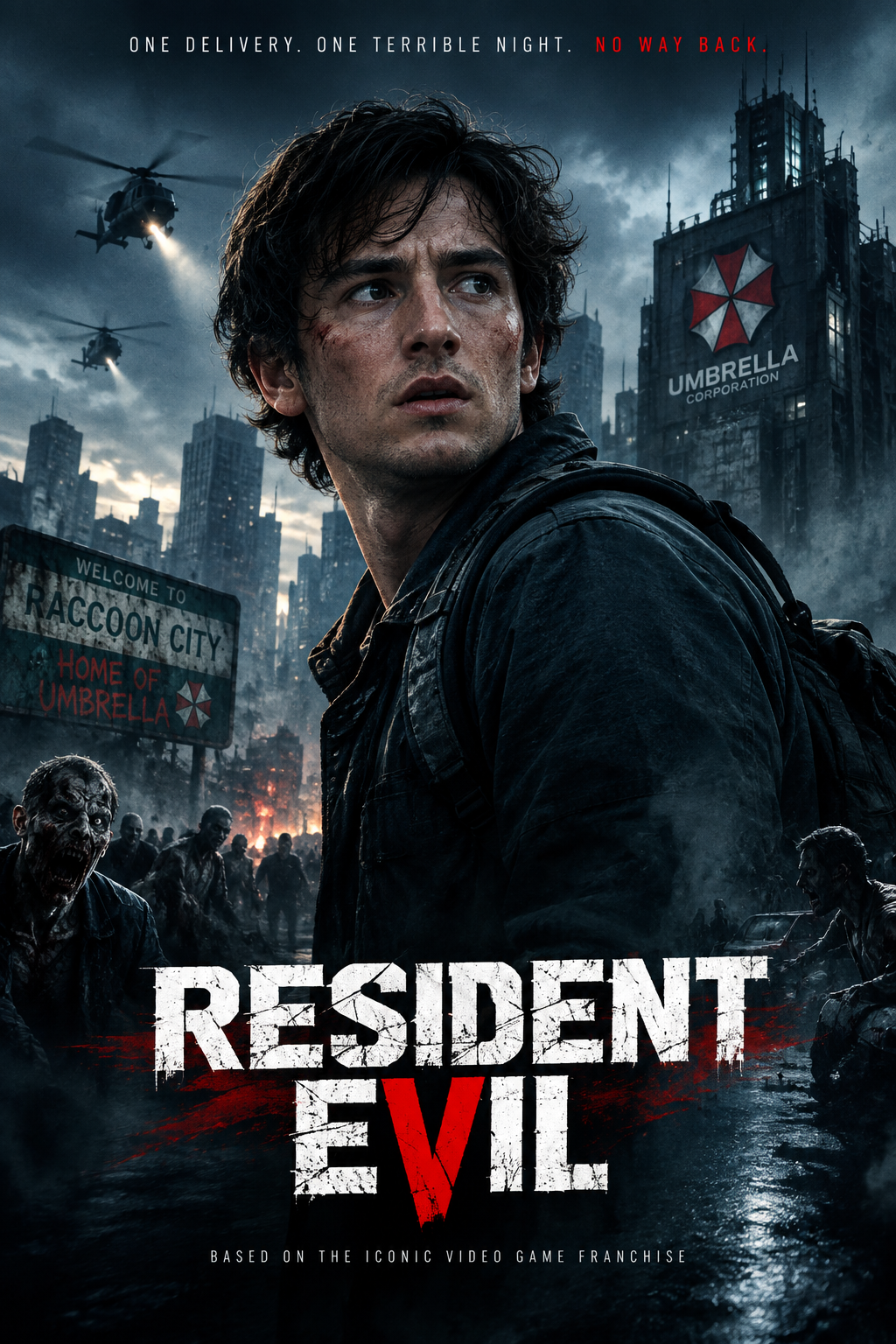
Resident Evil Review (2026): A Bloody, Strange and Surprisingly Human Survival-Horror Reboot
Original ReviewQuick Verdict
Resident Evil (2026) is a fast-moving horror reboot that understands one important thing about the games: sometimes the fun comes from being completely unprepared.
Austin Abrams makes Bryan believable as an ordinary man who keeps making decisions under pressure rather than suddenly becoming an action hero. The movie also has some memorable creature work, strong practical-looking horror moments and a visual style that occasionally feels like a game without becoming a literal imitation.
The story is deliberately simple, and that will divide viewers who expect a larger mythology. But the simplicity also keeps the film moving.
Austin Abrams makes Bryan believable as an ordinary man who keeps making decisions under pressure rather than suddenly becoming an action hero. The movie also has some memorable creature work, strong practical-looking horror moments and a visual style that occasionally feels like a game without becoming a literal imitation.
The story is deliberately simple, and that will divide viewers who expect a larger mythology. But the simplicity also keeps the film moving.
Story & Plot
Bryan begins the movie with a fairly ordinary problem: he has work to finish.
His job as a medical courier takes him toward Raccoon City with a mysterious package. He doesn't know that the city is becoming a nightmare filled with infected people and creatures that barely resemble anything human.
The important detail is that Bryan isn't prepared for this.
He isn't walking into Raccoon City because he wants to investigate Umbrella Corporation. He isn't chasing a monster. He isn't trying to save the world. He is simply trying to complete a job and get home.
That makes the early horror more effective because every new problem feels like something Bryan has no idea how to handle.
The movie moves him through several increasingly strange environments, almost like levels in a survival-horror game. A farmhouse, roads, abandoned spaces, underground areas and eventually the hospital each introduce a different kind of threat.
The simplicity of the setup is actually one of the film's strengths. There isn't a giant mythology lecture every twenty minutes. The audience discovers the situation alongside Bryan.
At the same time, his personal life gives the story a little more weight. His conversations with Michelle and the pregnancy discussion create a second problem underneath the monster story: Bryan is also struggling with the idea of becoming a father.
That thread becomes increasingly important as the night gets worse.
His job as a medical courier takes him toward Raccoon City with a mysterious package. He doesn't know that the city is becoming a nightmare filled with infected people and creatures that barely resemble anything human.
The important detail is that Bryan isn't prepared for this.
He isn't walking into Raccoon City because he wants to investigate Umbrella Corporation. He isn't chasing a monster. He isn't trying to save the world. He is simply trying to complete a job and get home.
That makes the early horror more effective because every new problem feels like something Bryan has no idea how to handle.
The movie moves him through several increasingly strange environments, almost like levels in a survival-horror game. A farmhouse, roads, abandoned spaces, underground areas and eventually the hospital each introduce a different kind of threat.
The simplicity of the setup is actually one of the film's strengths. There isn't a giant mythology lecture every twenty minutes. The audience discovers the situation alongside Bryan.
At the same time, his personal life gives the story a little more weight. His conversations with Michelle and the pregnancy discussion create a second problem underneath the monster story: Bryan is also struggling with the idea of becoming a father.
That thread becomes increasingly important as the night gets worse.
Performances
Austin Abrams is the biggest reason the movie works.
Bryan is frightened, confused and occasionally completely out of his depth. Abrams doesn't play him like a secret action hero waiting for his big moment. He reacts like an ordinary person would react when something impossible suddenly starts chasing him.
That gives the horror a slightly awkward humor.
Paul Walter Hauser also brings personality to the movie as Carl, an Umbrella employee who knows considerably more about the outbreak than Bryan does. His appearance gives the story a welcome burst of eccentric energy.
Zach Cherry plays Dave, while Kali Reis appears as Maxine. The supporting cast isn't given enormous amounts of character development because the movie is moving quickly, but they help expand Bryan's journey beyond a series of solo encounters.
The film's real character is Bryan himself. That is a smart choice for a story this short.
Bryan is frightened, confused and occasionally completely out of his depth. Abrams doesn't play him like a secret action hero waiting for his big moment. He reacts like an ordinary person would react when something impossible suddenly starts chasing him.
That gives the horror a slightly awkward humor.
Paul Walter Hauser also brings personality to the movie as Carl, an Umbrella employee who knows considerably more about the outbreak than Bryan does. His appearance gives the story a welcome burst of eccentric energy.
Zach Cherry plays Dave, while Kali Reis appears as Maxine. The supporting cast isn't given enormous amounts of character development because the movie is moving quickly, but they help expand Bryan's journey beyond a series of solo encounters.
The film's real character is Bryan himself. That is a smart choice for a story this short.
Direction
Zach Cregger approaches Resident Evil less like a traditional franchise sequel and more like a survival-horror experiment.
The screenplay doesn't spend too much time introducing complicated relationships or explaining decades of fictional history. Instead, it keeps asking a basic question:
What happens to this ordinary guy if the nightmare gets worse every few minutes?
That structure gives the film momentum.
There are also clear game-inspired ideas in the way Bryan moves through different environments, searches for solutions and encounters threats with different behaviors. Entertainment Weekly notes the movie's use of recognizable gameplay ideas such as limited ammunition, over-the-shoulder perspectives, puzzles and other visual references to the games.
The weakness is that the supporting characters sometimes feel more like pieces of Bryan's journey than fully developed people.
But considering the short runtime, the screenplay makes a reasonable trade: pace over mythology.
The screenplay doesn't spend too much time introducing complicated relationships or explaining decades of fictional history. Instead, it keeps asking a basic question:
What happens to this ordinary guy if the nightmare gets worse every few minutes?
That structure gives the film momentum.
There are also clear game-inspired ideas in the way Bryan moves through different environments, searches for solutions and encounters threats with different behaviors. Entertainment Weekly notes the movie's use of recognizable gameplay ideas such as limited ammunition, over-the-shoulder perspectives, puzzles and other visual references to the games.
The weakness is that the supporting characters sometimes feel more like pieces of Bryan's journey than fully developed people.
But considering the short runtime, the screenplay makes a reasonable trade: pace over mythology.
Cinematography
The cinematography by Dariusz Wolski is one of the more interesting parts of the movie.
The camera frequently puts us close to Bryan's perspective. At certain moments it feels as though the audience is looking around a game environment, waiting to discover what is hiding around the next corner.
Rotten Tomatoes' roundup of early reviews specifically highlights the way Wolski uses different camera modes and perspective-driven photography, including techniques that echo the games' third-person viewpoint.
The lighting also helps establish the mood. Snowy roads, dark interiors, industrial spaces and brightly lit laboratory areas give the film several different visual identities.
It isn't beautiful in a polished blockbuster sense all the time. It is often dirty, cold and uncomfortable.
That suits the story.
The camera frequently puts us close to Bryan's perspective. At certain moments it feels as though the audience is looking around a game environment, waiting to discover what is hiding around the next corner.
Rotten Tomatoes' roundup of early reviews specifically highlights the way Wolski uses different camera modes and perspective-driven photography, including techniques that echo the games' third-person viewpoint.
The lighting also helps establish the mood. Snowy roads, dark interiors, industrial spaces and brightly lit laboratory areas give the film several different visual identities.
It isn't beautiful in a polished blockbuster sense all the time. It is often dirty, cold and uncomfortable.
That suits the story.
Music
The music does not try to overpower every scene.
Instead, it supports the tension and helps the movie move between horror and dark comedy. That balance matters because Resident Evil is not completely serious.
Some scenes need silence or environmental sound more than a huge musical cue. The movie understands that a strange noise coming from somewhere off-screen can sometimes be more effective than an obvious horror soundtrack.
The overall sound design also gives the creatures considerable presence.
Instead, it supports the tension and helps the movie move between horror and dark comedy. That balance matters because Resident Evil is not completely serious.
Some scenes need silence or environmental sound more than a huge musical cue. The movie understands that a strange noise coming from somewhere off-screen can sometimes be more effective than an obvious horror soundtrack.
The overall sound design also gives the creatures considerable presence.
What Works
The biggest success is Austin Abrams as Bryan.
The movie also benefits from its compact runtime. It doesn't take long to reach the central problem, and once Bryan enters the nightmare, the story rarely stays still.
The creatures are another highlight. Instead of giving the audience only standard zombies, the film keeps introducing mutations with different shapes and behaviors.
That unpredictability gives the horror some personality.
The game influence is also handled intelligently. Rather than simply copying famous scenes, Cregger borrows the feeling of exploration, limited resources, environmental puzzles and escalating encounters.
And then there is the humor.
Some jokes are deliberately awkward, especially when Bryan reacts to situations that are far beyond his understanding. That gives the film a slightly strange personality rather than making it another completely straight-faced zombie thriller.
The movie also benefits from its compact runtime. It doesn't take long to reach the central problem, and once Bryan enters the nightmare, the story rarely stays still.
The creatures are another highlight. Instead of giving the audience only standard zombies, the film keeps introducing mutations with different shapes and behaviors.
That unpredictability gives the horror some personality.
The game influence is also handled intelligently. Rather than simply copying famous scenes, Cregger borrows the feeling of exploration, limited resources, environmental puzzles and escalating encounters.
And then there is the humor.
Some jokes are deliberately awkward, especially when Bryan reacts to situations that are far beyond his understanding. That gives the film a slightly strange personality rather than making it another completely straight-faced zombie thriller.
What Doesn’t Work
The biggest weakness is the limited character development outside Bryan.
The film introduces several people who could have supported larger emotional arcs, but the story doesn't have much time for them.
The plot is also intentionally straightforward. If you're looking for an elaborate Resident Evil conspiracy with lots of familiar characters and mythology, this movie may feel surprisingly small.
Some later sequences also become more spectacle-driven than frightening.
The movie is at its strongest when Bryan is trapped somewhere and has to figure out what to do next. Once the chaos becomes extremely large, some of that intimate tension disappears.
The film introduces several people who could have supported larger emotional arcs, but the story doesn't have much time for them.
The plot is also intentionally straightforward. If you're looking for an elaborate Resident Evil conspiracy with lots of familiar characters and mythology, this movie may feel surprisingly small.
Some later sequences also become more spectacle-driven than frightening.
The movie is at its strongest when Bryan is trapped somewhere and has to figure out what to do next. Once the chaos becomes extremely large, some of that intimate tension disappears.
Who Should Watch
This movie should appeal to viewers who enjoy:
Survival horror
Zombie movies
Video-game adaptations
Creature horror
Dark comedy
Short, fast-paced thrillers
Resident Evil games
Horror movies with practical-looking monsters
It can also work for newcomers because you don't need extensive knowledge of previous Resident Evil movies to understand Bryan's situation.
Survival horror
Zombie movies
Video-game adaptations
Creature horror
Dark comedy
Short, fast-paced thrillers
Resident Evil games
Horror movies with practical-looking monsters
It can also work for newcomers because you don't need extensive knowledge of previous Resident Evil movies to understand Bryan's situation.
Additional Editorial Notes
Pros
Austin Abrams gives Bryan personality
Strong survival-horror atmosphere
Creative creature designs
Good use of game-inspired visual language
Short runtime keeps the story moving
Mixes horror and dark humor effectively
Accessible to newcomers
Cons
Supporting characters are underdeveloped
Story is deliberately simple
Some later action loses the earlier tension
Heavy gore won't suit every viewer
Franchise mythology is relatively limited
Rating Breakdown
Category Score
Story 7.5/10
Performances 8.5/10
Direction 8.5/10
Cinematography 8/10
Music & Sound 8/10
Horror 8.5/10
Entertainment 8.5/10
Overall 8/10
YoMovies2 Rating: 4/5
Austin Abrams gives Bryan personality
Strong survival-horror atmosphere
Creative creature designs
Good use of game-inspired visual language
Short runtime keeps the story moving
Mixes horror and dark humor effectively
Accessible to newcomers
Cons
Supporting characters are underdeveloped
Story is deliberately simple
Some later action loses the earlier tension
Heavy gore won't suit every viewer
Franchise mythology is relatively limited
Rating Breakdown
Category Score
Story 7.5/10
Performances 8.5/10
Direction 8.5/10
Cinematography 8/10
Music & Sound 8/10
Horror 8.5/10
Entertainment 8.5/10
Overall 8/10
YoMovies2 Rating: 4/5
Final Verdict
Resident Evil (2026) doesn't try to solve the franchise by making everything bigger.
Instead, it makes the situation smaller and more personal.
One courier. One delivery. One infected city. One increasingly impossible journey home.
That simplicity gives Zach Cregger room to concentrate on atmosphere, creature design and Bryan's increasingly desperate attempts to survive. Austin Abrams keeps the central character grounded, while the game-inspired camera work and environmental progression make the film feel connected to the source material without simply recreating a game scene by scene.
The movie isn't flawless. Some supporting characters needed more development, the later chaos occasionally sacrifices tension, and viewers wanting a large Resident Evil mythology story may find this version surprisingly stripped down.
But as a self-contained survival-horror movie, it has a clear identity.
YoMovies2 Rating: 4/5
Final Verdict:
Resident Evil is a bloody, fast-moving and unexpectedly human survival-horror reboot that trades complicated franchise lore for one ordinary man's terrifying fight to make it home.
Instead, it makes the situation smaller and more personal.
One courier. One delivery. One infected city. One increasingly impossible journey home.
That simplicity gives Zach Cregger room to concentrate on atmosphere, creature design and Bryan's increasingly desperate attempts to survive. Austin Abrams keeps the central character grounded, while the game-inspired camera work and environmental progression make the film feel connected to the source material without simply recreating a game scene by scene.
The movie isn't flawless. Some supporting characters needed more development, the later chaos occasionally sacrifices tension, and viewers wanting a large Resident Evil mythology story may find this version surprisingly stripped down.
But as a self-contained survival-horror movie, it has a clear identity.
YoMovies2 Rating: 4/5
Final Verdict:
Resident Evil is a bloody, fast-moving and unexpectedly human survival-horror reboot that trades complicated franchise lore for one ordinary man's terrifying fight to make it home.